Hey there, if you’re running a warehouse, construction site, or any spot that relies on heavy lifting, you’ve probably stared at your diesel forklift’s tire pressure gauge at 2 a.m. wondering, “Is this right?” I get it—forklift tires aren’t like your car’s: they’re bigger, work way harder, and one wrong pressure call can turn a routine shift into a breakdown or, worse, a safety hazard. As a diesel forklift supplier who’s fielded a hundred questions on this exact topic, let’s break this down without the jargon, no stuffy manuals here. Diesel Forklift
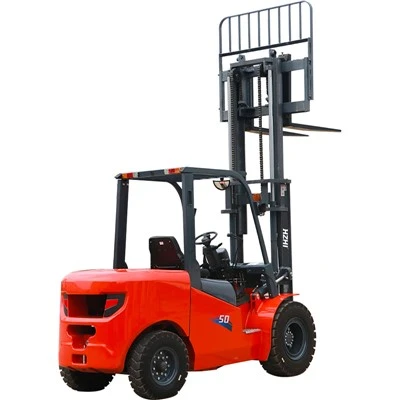
First, let’s start with why tire pressure for a diesel forklift isn’t a one-size-fits-all number. Your car’s tire pressure might be printed on the door jamb, but forklifts? They’re built for way different loads. A diesel forklift is heavier than a gas or electric one—we’re talking extra weight from the engine, the hydraulic system, and the frame that can handle 5,000 to 50,000 lbs of load. Skimp on pressure, and those tires’ll flat mid-lift. Overinflate, and you’ll get a rough ride, less traction on wet or slick floors, and even more wear on your forklift’s suspension. That’s why there’s no single “correct” pressure—just a range that depends on three big things: your forklift model, the tires you’re running, and what you’re lifting.
Let’s get to the hard numbers, but keep it real. Most standard 5,000 lb capacity diesel forklifts (super common at warehouses) run front tire pressures between 18 and 22 PSI, and rears around 14 to 18 PSI. Wait, why front vs rear? Because when you’re lifting a heavy load, 70-80% of the forklift’s weight shifts to the front tires. So fronts need more pressure to hold that load. For a bigger, 10,000 lb diesel forklift, bump that up to 22-26 PSI for fronts, 18-20 for rears. If you’re running solid pneumatic tires (the thick, rubber ones that last forever for rough construction sites), add 2-3 PSI to that range—they’re stiffer, so they need a bit more to support heavy off-road loads.
Now, I know what you’re thinking: “But my old manual says 20 PSI for fronts—should I just go with that?” Hold up, manuals are a great starting point, but they’re not gospel. Let’s test it in real life. Last month, a guy with a 6,000 lb diesel forklift told me he was running 25 PSI on fronts, per the old manual. He complained his tires were wearing out fast, and he was getting stuck on the dock ramps. We checked, and his manual was from 10 years ago—his tires had been upgraded to heavy-duty ones for loading docks. We dropped his front pressure to 19 PSI, and boom—tire wear slowed down, traction got way better. That’s why checking your actual current setup matters, not just the manual.
Another big mistake I see: people only check tire pressure once a month, or when they remember. But diesel forklifts work hard. If you’re running yours 8 hours a day on concrete, the tires heat up, and that pressure can change by 2-3 PSI within a shift. Cold pressure is the only pressure that counts. What’s cold? When the forklift’s been sitting for at least 2 hours, or hasn’t been driven more than a mile. If you check hot, you’ll overinflate them, and that’s bad. We tell all our customers to do a pressure check first thing in the morning, before their first lift—easy, 2 minutes a day, saves you hundreds in tire replacements.
Wait, what about underinflation vs overinflation? Let’s make this simple. Underinflation is the bigger danger here. If a tire’s 5 PSI low, that’s like driving on a flat tire—even if it looks fine. The sidewalls flex too much, generate extra heat, and can blow out mid-operation. I had a customer last year who ignored a slow leak in his front tire, and it blew while he was lifting a 12,000 lb pallet of steel. The load shifted, he totaled a pallet rack, and missed a full week of orders. Not worth it. Overinflation’s less catastrophic, but still a pain: you get a bumpy ride, which makes lifting heavy loads less accurate, and the center of gravity shifts, increasing the risk of tipping. Forklift tips are the number one cause of warehouse injuries—don’t let tire pressure play a part.
Now, let’s tie this to the type of work you’re doing. If you’re running a diesel forklift in a tight warehouse with smooth concrete, you can stick to the lower end of the pressure range. If you’re on a construction site with gravel, dirt, or uneven ground, bump up to the higher end to get better traction. And if you’re lifting extra heavy loads (like 15,000 lbs or more), add 2 PSI to the front tires—no exceptions. I always tell customers: “Your forklift’s tire pressure is a safety feature, not a random number.”
I should also mention that not all tires are the same. If you’re using pneumatic tires (the ones that hold air, good for indoor and outdoor use) vs solid non-marking tires (for food processing or clean rooms), the pressure changes. Solid tires are solid rubber, no air, so you don’t have to check PSI for them—wait, no, solid tires don’t inflate, so their pressure doesn’t matter. But if you’re running pneumatic, make sure you’re using the right compressor. A lot of people use a car tire compressor, which doesn’t give enough PSI accuracy. Get a heavy-duty compressor made for industrial tires, it’s worth the $50 investment.
Let’s get specific with a quick example. Suppose you have a 7,000 lb capacity diesel forklift, running standard pneumatic tires, working in a warehouse 8 hours a day. Cold pressure should be: Fronts: 20 PSI, Rears: 16 PSI. If you’re moving pallets across a loading dock with ramps, bump fronts to 21 PSI. If you’re moving to a construction site with rough dirt, bump fronts to 22 PSI, rears to 17 PSI. That’s the kind of small adjustment that makes a huge difference.
Now, let’s talk about common myths. Myth #1: “Harder pressure means more load capacity.” No, that’s not how it works. Load capacity is rated by the forklift manufacturer, not tire pressure. Too much pressure just makes the tire stiffer, which reduces contact with the ground, so you get less traction, not more. Myth #2: “If the tire looks full, it’s right.” No, a tire that looks full might still be 5 PSI low, which is a big problem. Always use a tire gauge—no guessing. Even a cheap digital gauge is accurate enough for this work. Myth #3: “Diesel forklifts need more pressure than electric.” Wait, they are heavier, so yes, a bit more, but the difference is only 2-3 PSI, not a huge gap. Electric forklifts are lighter, so their pressure is a bit lower, but not by much.
As a diesel forklift supplier, I see this stuff every day. Last quarter, we hosted a free demo day for a group of warehouse managers, and half of them were running tire pressure that was 4-5 PSI off. One guy was running his front tires at 14 PSI—he told me he did it because “they look softer that way.” I walked him through the numbers, showed him the wear on his tires, and within a week, he saved $1,200 in tire replacements. That’s the impact getting this right has.
So, how do you nail this? Step 1: Find your forklift’s model number (it’s on a plate on the frame, near the driver’s seat) and check the manufacturer’s recommended range as a base. Step 2: Adjust for your tire type and work environment—off-road = higher pressure, smooth warehouse = lower. Step 3: Check cold pressure every morning, use an accurate gauge. Step 4: If you’re in doubt, test it. Run the lower end for a week, check tire wear, if you’re getting too much slip, bump it up a PSI or two. No need to overcomplicate it.
Now, if you’re shopping for a new diesel forklift, or you’re having trouble with tire pressure, breakdowns, or just want to make sure your current setup is safe, we can help. We sell all types of diesel forklifts, from 2,000 lb to 50,000 lb capacity, and we work with customers to tailor tire pressure recommendations based on their specific job. Whether you’re running a small warehouse or a big construction site, we’ve got the knowledge to get you set up right. Just reach out to talk through your needs, no pressure, no sales pitch—just a quick chat about how to keep your forklift running smooth.
References
Manual Stacker Industrial Tire & Rim Association. (2022). Forklift Tire Pressure Guidelines for Industrial Applications. National Institute for Occupational Safety and Health (NIOSH). (2021). Forklift Safety: Tire Maintenance Best Practices. Toyota Material Handling. (2023). Diesel Forklift Operator Manuals: Tire Pressure Specifications for Heavy-Duty Models.
Huazheng Heavy Industry Machinery Equipment Co., Ltd.
With abundant experience, we are one of the most professional diesel forklift manufacturers and suppliers in China. Please feel free to buy high quality diesel forklift for sale here from our factory. We also accept customized orders.
Address: Room 423-101, Building C-4, Electronics Valley Technology Center, No.3088 Lekai North Street, Gaokai District, Baoding City, Hebei Province, China
E-mail: sales02@hzheavy.com
WebSite: https://www.hzheavy.com/
