Hey everyone, it’s Jake here from your go-to lowbed semi trailer supplier – and today I’m diving into something that trips up so many new haulers: keeping your cargo balanced on a lowbed. I’ve been around these trailers for 12 years, seen more load shifts than I can count (most of them messy), and let me tell you – balanced cargo isn’t just about “making things fit.” It’s about not wasting fuel, keeping your trailer legal, and most importantly, not turning a routine haul into a disaster that lands you a fine, or worse, causes an accident. Lowbed Semi Trailer

A lot of first-timers think, “Oh, I’ll just stack all my heavy stuff in the middle, that’s enough.” Nope. Lowbeds are different from dry vans or flatbeds – their design is low to the ground for oversized gear, but that also means even a tiny shift can mess with center of gravity, tire pressure, and steering. Last year, a guy from a construction company called me panicking because he hauled three excavators – he’d shoved all the heavy ones toward the back, and when he hit a slight curve on the highway, the back end slid way too far, he almost jackknifed, and ended up with a $1,800 DOT fine on top of $3k in trailer damage. That’s exactly why I’m breaking this down, no boring manuals, just real stuff I’ve learned from working with hundreds of haulers over the years.
First off, let’s talk center of gravity (CG) – this is the big one, and it’s non-negotiable for lowbeds. Unlike regular trailers where you can shift heavy loads a foot or so without major issues, lowbeds have their kingpin (the part that connects to your truck) much lower, and a higher deck clearance? Wait no, actually, the deck is low, so the CG of your cargo can’t sit too high, and can’t be off-center left or right, or front to back. Let’s start front to back because that’s the most common mistake. The rule here is: 60% of your total cargo weight needs to sit on the trailer’s tandem axles – that’s the two sets of wheels under the main lowbed, not the gooseneck (the part that sticks up to connect to the truck) or the rear extension if you have one for extra-long loads. Wait, let’s make that super clear. Say your lowbed has a gooseneck section, the main drop deck (where most cargo goes), and a rear overhang beam. If you haul 40,000 lbs total, 24,000 of that has to be over those tandem axles. If you put 15k on the gooseneck? That messes with your truck’s steering – your front tires will wear out faster, and you’ll get terrible gas mileage. Put 15k on the rear overhang? The back end dips way too low, you risk hitting speed bumps, curbs, or even the road surface if you hit a pothole, and that can cause the cargo to tip backward.
I had a customer last month hauling a 12,000 lb bulldozer – he tried to save space by sliding it all the way back so the front of the dozer hung over the rear of the trailer. We checked his load before he left our lot, and his rear axle weight was 18k, but the gooseneck was only carrying 2k – that put 90% of the weight over the rear, which is way over legal limits (each tandem axle set can only handle 34k total, but even so, the CG was so far back that if he slammed on his brakes, the dozer could have slid right off the back. We adjusted it: moved the dozer forward 6 feet, so now the tandem axles had 7.2k of that 12k, plus another 8.8k of his other equipment, so total tandem weight was right at 20k for that part, and the gooseneck was carrying 3k. Perfect, and he called me a week later saying the haul went totally smooth. That’s the kind of small shift that makes all the difference.
Now, left to right balance – this is another one that people sleep on, and it’s even more important for lowbeds because of their narrow deck (well, most standard lowbeds are 8.5ft wide, some are wider for oversize, but even so). If you load all heavy stuff on one side, your trailer will lean, and that throws off your steering and tire wear. Let’s say you’re hauling a large industrial generator that weighs 8,000 lbs. If you set it 2 feet to the left of the trailer’s center line, the right side of the deck is now lighter, and when you take a turn, that lean gets way worse. I always tell my customers: when placing heavy items, line up their center point exactly with the trailer’s center line – you can even run a tape measure between the side rails to mark the middle if you need to. If you have two heavy items, place them symmetrically. Like, if you have two 5k tanks, put one on the left half of the deck and one on the right half, same distance from the center, same distance from the axles. That way, there’s no side-to-side weight difference, and your trailer tracks straight down the road without you having to fight the steering wheel the whole time. Side-to-side imbalance also causes uneven tire wear – one set of tires will wear out in half the time, which is just throwing money away.
Next up, cargo distribution by weight class – not all cargo is the same, and shoving all heavy stuff in the middle isn’t enough if you mix heavy and light items wrong. I see this all the time: haulers load all their lightweight stuff (like pallets of construction supplies, or empty containers) first, then stack heavy stuff on top. That’s a recipe for CG that’s way too high, which makes the trailer top-heavy and way more likely to tip if you hit a bump or a curve fast. The rule here is: heavy, dense cargo goes low, light, bulky cargo goes high. For example, if you’re hauling a set of steel beams (super heavy, dense) and a bunch of plastic piping (light, bulky), set the steel beams directly on the lowbed deck, evenly spaced, then stack the piping on top of them. Don’t put the steel beams on the top of a stack and the piping at the bottom – that raises your overall CG by 1-2 feet, which might not sound like much, but on a lowbed, that’s enough to make the trailer unstable. Also, if you have any loose cargo (like gravel, or sand, or construction debris), make sure it’s placed in the center and secured properly, not piled on one side. Loose material shifts way easier than solid, heavy items, so that’s a big one.
Now, securing the cargo – this is part of balance too, right? If your cargo isn’t secured right, it will shift, no matter how well you placed it. I always say, balance without securement is just a nice idea. For lowbeds, you’ve got D-rings along the side rails, and stake pockets, and sometimes winches, so use all of them. A common mistake is only using one strap per corner of a heavy item. I tell customers: for any item over 5,000 lbs, use at least two straps per side, crisscrossed if possible, and ratchet them tight but not so tight that you bend the D-rings. Also, use edge protectors on straps where they touch sharp cargo – like steel edges or concrete blocks – because sharp edges cut straps, and then your cargo can shift. Pro tip: when you’re tightening straps, stand to the side, not directly over the strap, in case it breaks and snaps back. I’ve seen a strap break and knock a guy out, so safety first.
Another thing that no one talks about: checking your weight before you leave. A lot of haulers skip weighing their loaded trailer, or just weigh the whole thing on a regular scale, but you need to weigh the axles individually to make sure the weight distribution is right. Most truck stops have axle scales – they’re those little pads in the ground that you drive over one set of axles at a time. Bring a friend or use a weigh station if you can, but even a quick check with axle scales will tell you if you have too much weight on the gooseneck, too much on the rear, or a side-to-side difference. Last month, a guy called me and said his trailer felt “floaty” on the highway, and when we told him to weigh the axles, he found the rear tandem was carrying 10k more than the front tandem. That meant his CG was way back, and he was at risk of tipping if he had to brake hard. He moved 2,000 lbs of light cargo from the rear to the gooseneck, and that fixed it. Weighing isn’t a hassle, it’s 10 minutes of work that saves you thousands in fines and accidents.
Wait, also, what about oversize loads? I see a lot of people hauling oversize gear with lowbeds, like big transformers or construction equipment, and they think because it’s wide or long, they can fudge the balance a little. No way. Oversize loads have even stricter CG rules because they’re more visible to wind, too. If you have an oversize load that’s wide, make sure the weight is evenly distributed left to right, and if it’s extra tall, lower it as much as possible on the trailer. Some lowbeds have detachable goosenecks that let you lower the deck even more, so use that option if you have a tall load – that lowers the CG, making the load way more stable in wind and turns. Wind is another factor with lowbeds, right? Because you’re low to the ground, but if your load extends out the sides, wind can push on it, and if the balance is off, that push can send the trailer swerving. So symmetric weight isn’t just for balance, it’s for wind resistance too.
Common mistakes I see over and over again: first, ignoring the 60% tandem axle rule. So many people load too much on the gooseneck because they think that frees up deck space, but that throws off steering and fuel economy, and can even cause the truck to tip forward if you brake hard. Second, stacking light stuff on top of heavy stuff, raising the CG too high. Third, skipping the individual axle weigh-in, just relying on a total trailer weight. Total weight being legal doesn’t mean your weight distribution is legal or safe. Fourth, under-securing cargo, especially on uneven loads. I had one customer a year ago whose load of steel pipes shifted because he only used two straps, and when he hit a bump, the pipes rolled to one side, tilted the trailer, and scratched the side of his new lowbed – he ended up paying $2,000 for repairs plus a day of downtime because he had to haul it to a shop. That could have been avoided with a couple more straps and a quick balance check.
So, let’s recap the step-by-step to make this easy, no more overcomplicating it. First, plan your load before you even start loading. List out all your cargo, note their weight and dimensions, and mark the center line of your lowbed with a piece of chalk or a tape measure. Second, place heavy, dense items low to the deck, centered left to right, so 60% of the total weight sits over the tandem axles. If you have multiple heavy items, space them evenly along the axles. Third, place light, bulky items on top of heavy ones, same left-right symmetry, don’t stack them too high to keep CG low. Fourth, secure every item: use 2+ straps per side for items over 5k lbs, crisscross straps, use edge protectors, don’t over-tighten. Fifth, weigh each set of axles at a truck stop or weigh station to confirm distribution is on point. Sixth, do a walkaround before you hit the road: check all straps, make sure no cargo is hanging uneven, check tire pressure, and give the trailer a visual for obvious lopsidedness.
If you follow these steps, you won’t have to deal with that stress I mentioned earlier – no fines, no accidents, no damaged trailers or cargo. Balancing a lowbed isn’t rocket science, it’s just about being intentional with where you place weight and making sure it’s secure.
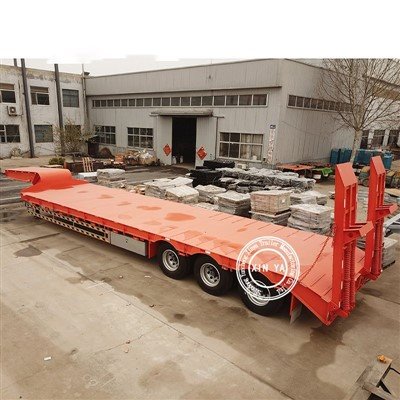
At the end of the day, as a lowbed semi trailer supplier, my goal isn’t just to sell you a trailer – it’s to make sure you use it safely and efficiently. If you’re new to hauling lowbeds, or you’ve had balance issues before, or you just have questions about a specific load you’re planning, hit us up to chat through it. We’re always here to help with tips, or if you’re in the market for a new lowbed that’s built with balanced hauling in mind, we can walk you through all the options to fit your needs. No confusing jargon, no sales pressure, just real advice from people who’ve been doing this for years. And if you have a tip I missed, drop it in the comments too – I’m always learning from other haulers.
Container Trailer References: Federal Motor Carrier Safety Administration. (2022). Cargo Securement Rules. U.S. Department of Transportation; National Association of Trailer Manufacturers. (2021). Safe Loading Guidelines for Lowbed Semi Trailers. NATM Industry Safety Report.
Shandong Yuncheng Xinya Trailer Manufacturing Co., Ltd.
Shandong Yuncheng Xinya Trailer Manufacturing Co., Ltd. is one of the most experienced lowbed semi trailer manufacturers and suppliers in China, featured by quality products and good service. Please rest assured to buy CE approved lowbed semi trailer from our factory. Contact us for customized service and OEM service.
Address: No. 008, Hexie Road, Yangzhuangji Town, Yuncheng County, Heze City, Shandong Province
E-mail: fiona@xinyatrailer.com
WebSite: https://www.china-truckfactory.com/
